

Jaecoo J5 review

Kushal Rajbhandari
· Oct 25, 2026
Good
A distinctive, generously equipped compact SUV with 130 kW charging on both trims, held back by touchscreen-only climate controls and front tyres that spin easily on loose climbs.
Kushal Rajbhandari
Oct 25, 2026
A distinctive, generously equipped compact SUV with 130 kW charging on both trims, held back by touchscreen-only climate controls and front tyres that spin easily on loose climbs.
Kushal Rajbhandari
Oct 25, 2026
What we like
- Distinctive, upright design that looks more expensive than it is
- Quiet cabin and sharper handling than most rivals
- Ventilated front seats, glass roof, powered tailgate and 540-degree camera as standard
- 185 mm ground clearance, short overhangs and a spare wheel suit rough Nepali roads
- Strong 155 kW motor pulls easily on tarmac climbs
- 13 service centres across the country, wider than most new brands
What could be better
- Climate, regen and mirror controls sit inside the touchscreen
- Front tyres spin easily on wet, loose or steep surfaces
- Top regen setting hesitates then lurches, with no one-pedal mode
- Firm ride over sharp stones and stone-paved roads
- Average efficiency, about 15 kWh per 100 km in mixed driving
- No crash-test rating, and SPG's own DC chargers top out at 30 kW
The Jaecoo J5 is a compact electric SUV that looks more expensive than it is and comes with almost everything on the options list as standard. Both trims share the same 155 kW motor, 130 kW DC charging, ventilated front seats, glass roof, powered tailgate and full driver-assist suite, so the choice comes down to battery size. The cabin relies too heavily on the touchscreen, the strongest regen setting is badly tuned, and the front tyres lose grip easily on loose or wet climbs.
SPG Automobiles launched the J5 at the NAIMA Nepal Mobility Expo in August 2025 and added a second trim at the NADA Auto Show in August 2026. The naming is the wrong way round: the J5 Pro is the cheaper car, with a 50.6 kWh battery and a claimed 405 km, while the plain J5 has a 58.9 kWh battery and a claimed 461 km. Both claims are on the NEDC cycle.
It suits families who want an SUV with presence, lots of kit and a workshop in most big towns, and who do most of their driving on tarmac. Buyers who care most about efficiency, or who want physical buttons for the climate, should also drive the BYD Atto 2.
Design, interior & features
Design and exterior8.0
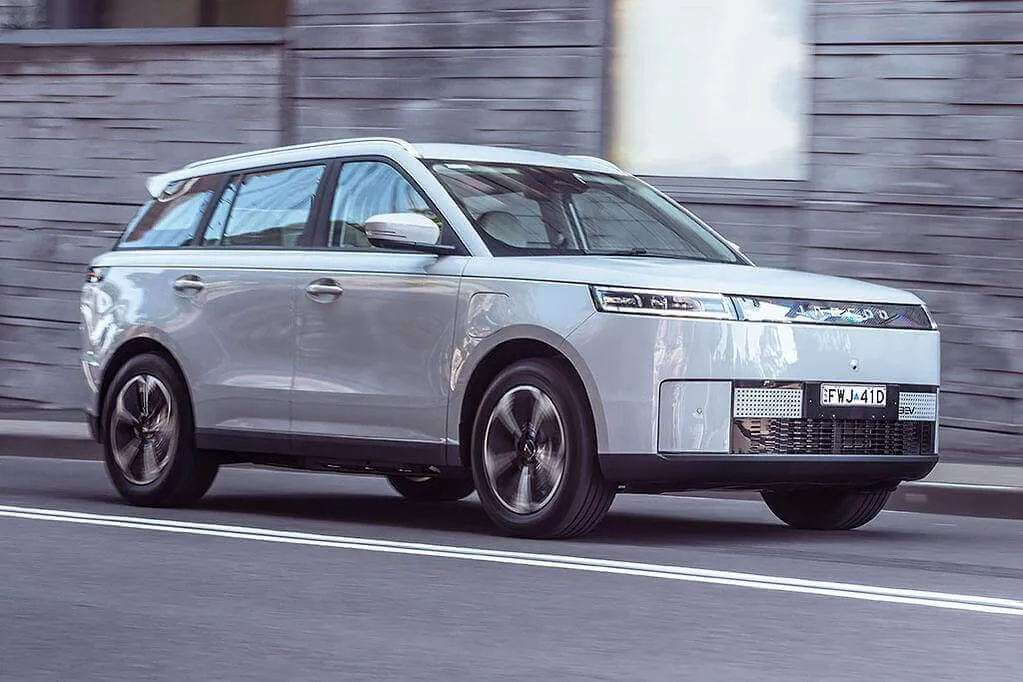
The J5 is upright and square-edged, with a flat bonnet, a near-vertical tailgate, a floating roof and thin LED strips front and rear. Almost everyone who sees it thinks of a small Range Rover, and in a segment of rounded crossovers it stands out more than the Atto 2, MG S5 or Leapmotor B03X.
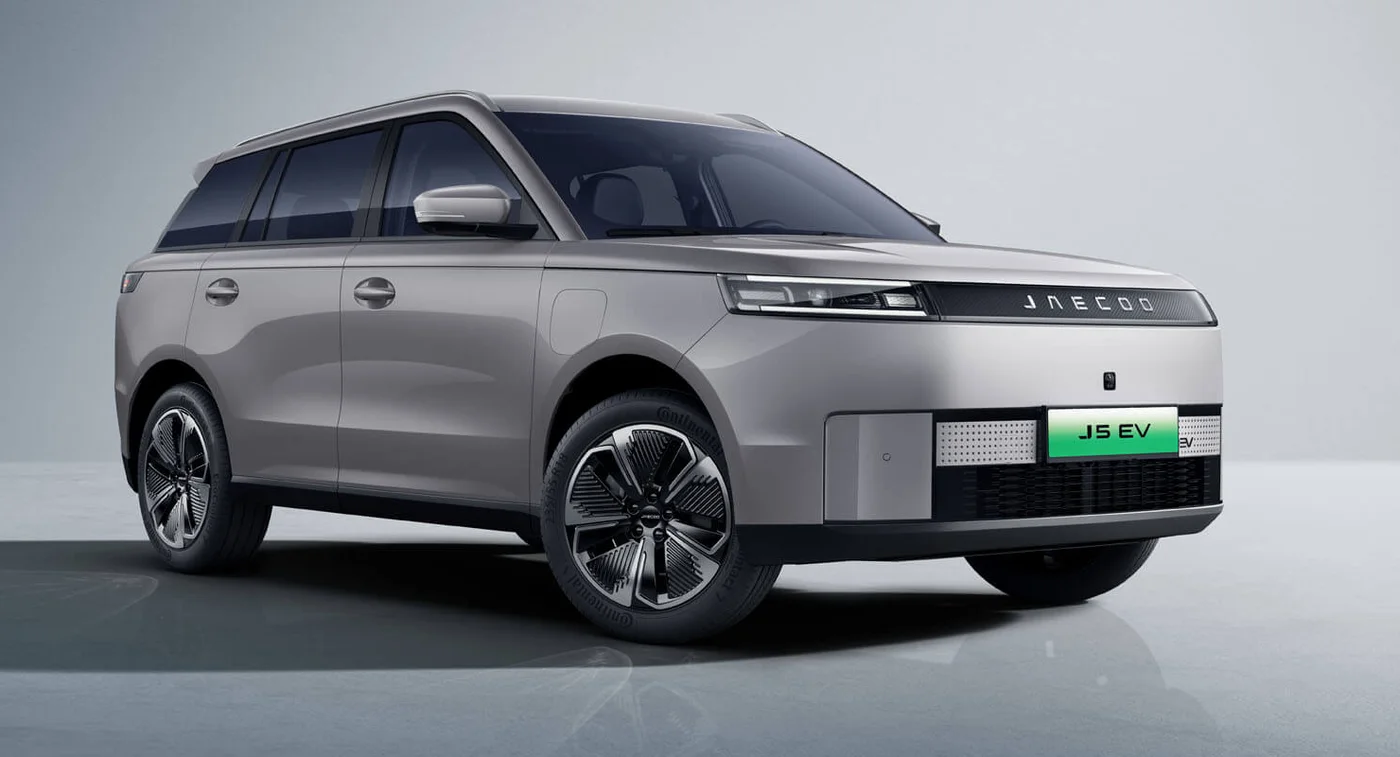
It measures 4,380 mm long, 1,860 mm wide and 1,650 mm tall on a 2,620 mm wheelbase, so it is about Atto 2 size on the road. The rear wiper hides under the spoiler, the charge-port flap opens electrically, and the door handles are conventional pull handles that work with wet or gloved hands. The lower front bumper is fussy, and the 18-inch wheels look a size small for the arches.
The tall glasshouse, thin pillars and flat bonnet make it easy to see out of and easy to place in tight lanes.
Interior, space and practicality7.0
The cabin feels better made than the price suggests. The dashboard and front door tops are soft to the touch, the column-mounted gear stalk frees the console for deep storage, and Nepali testers fitted one-litre bottles in the door bins. The rear door tops are hard plastic, and the gloss black trim collects dust and scratches. Cars built in 2026 feel tighter than the early 2025 cars, with better fit around the trim.
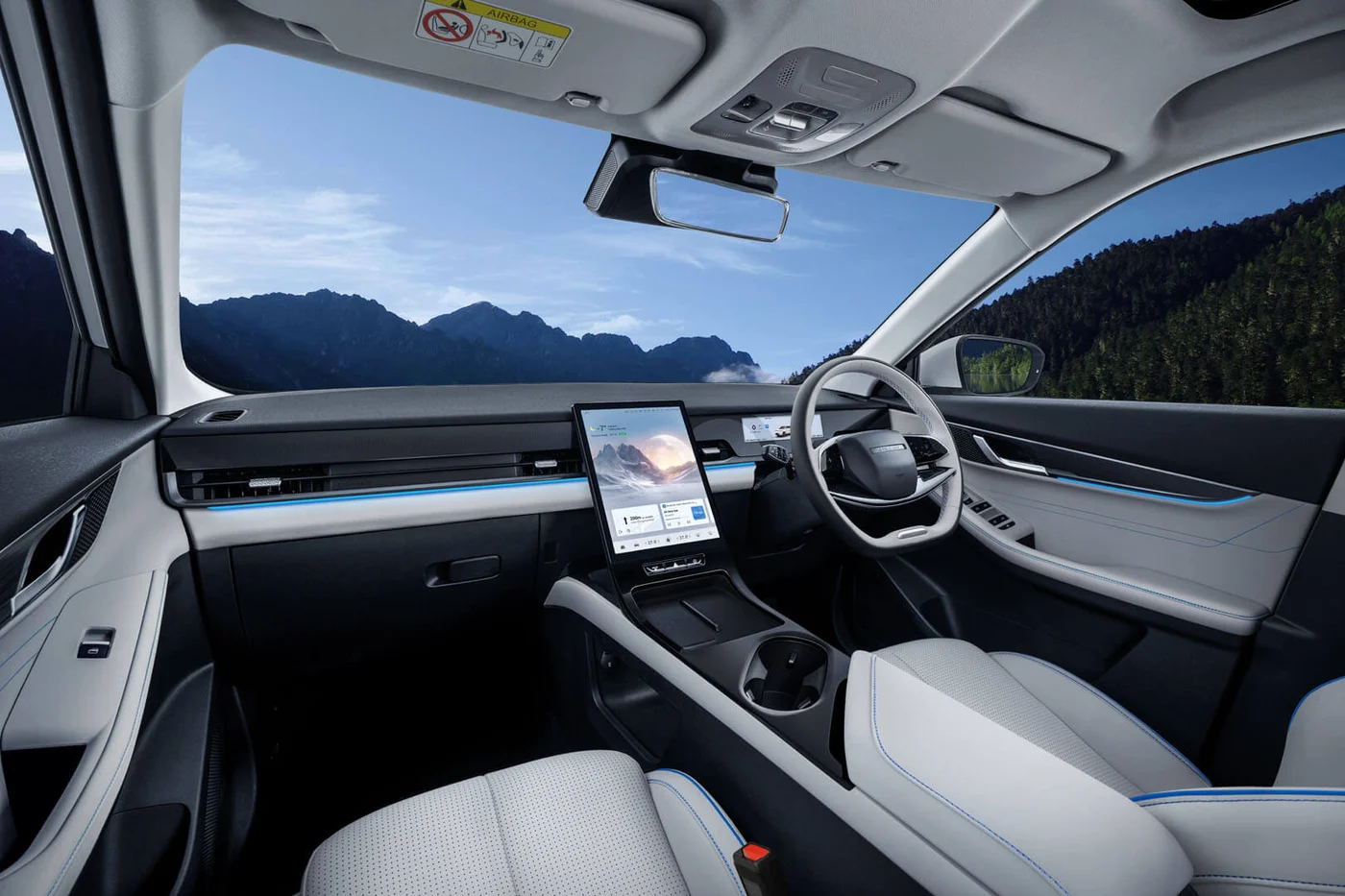
Two interior colours are offered. The light Mist Grey looks good in photos but will be hard to keep clean, so most Nepali buyers will be better served by Basalt Black. The front seats are firm and supportive over a normal day, though the passenger seat has no height adjustment.
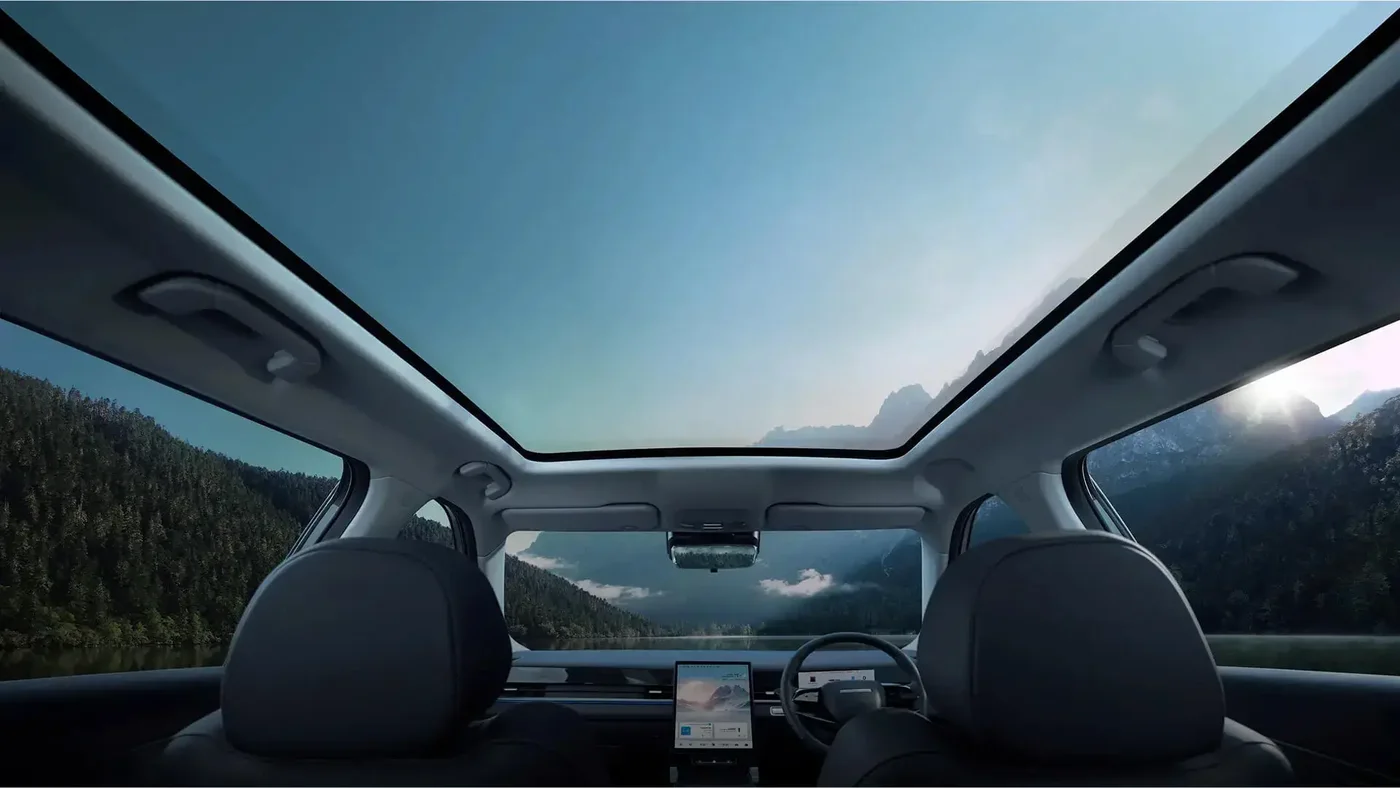
The rear is fine for two adults. Testers around 5 feet 9 inches had enough knee room and good thigh support, the floor is close to flat, and headroom is generous under the glass roof. Taller passengers will find knee room tight, and three across is a squeeze on longer trips. The backrest does not recline, and rear passengers get only one air vent and one USB-A port, with no USB-C.
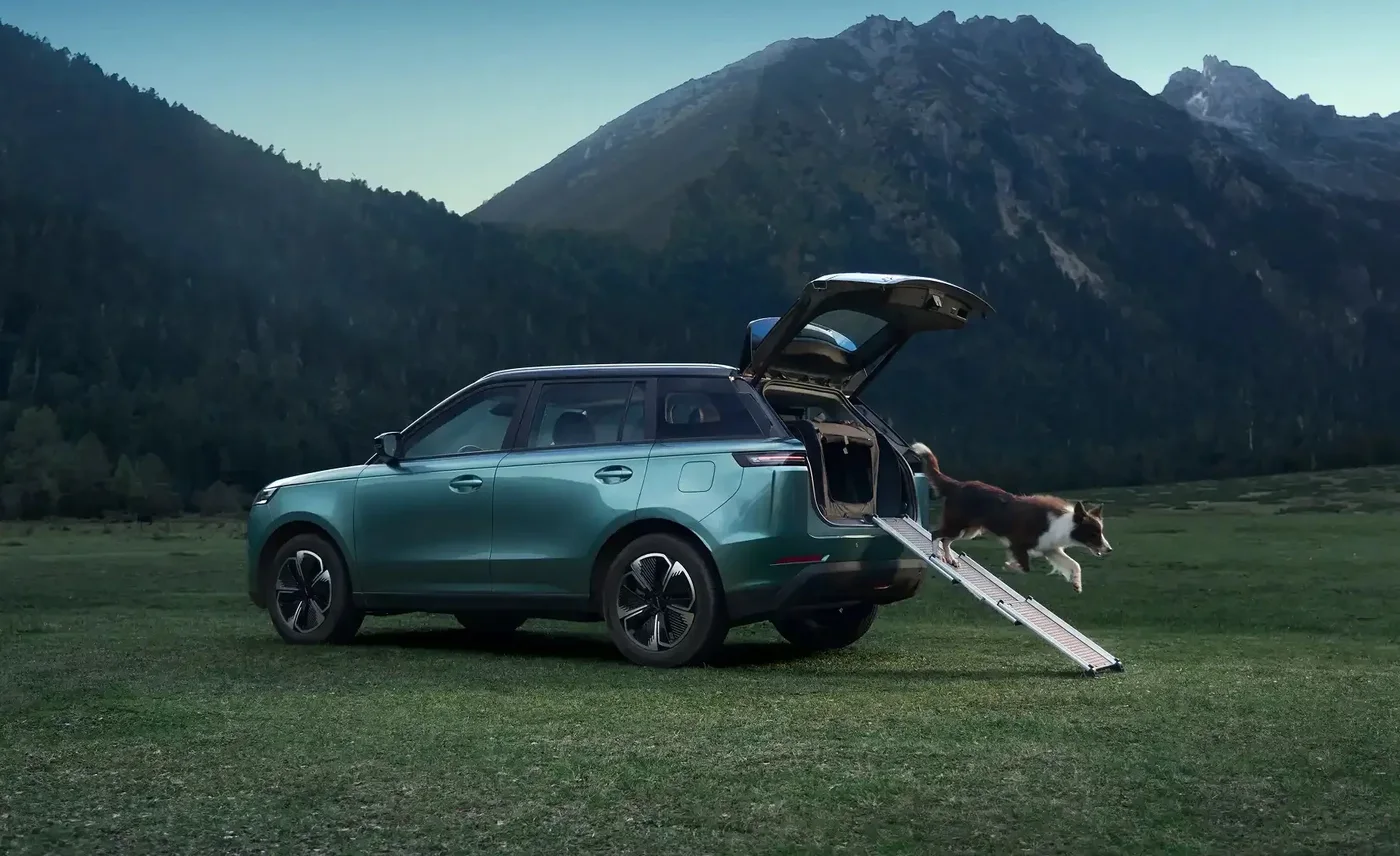
The boot holds 480 litres to the roof and about 1,180 litres with the 60:40 seat folded. It has a two-level floor, a 12 V socket and a powered tailgate. A 35-litre front boot takes the charging cable. Nepal cars also get a spare wheel, which overseas cars do without: a full-size alloy on the J5 and a space-saver on the J5 Pro.
Features and technology8.0
The equipment list is long, and both trims get all of it. It includes a portrait touchscreen with wireless Apple CarPlay and Android Auto, a digital driver display, a wireless charging pad, dual-zone climate control with a PM2.5 filter, ventilated front seats, a heated steering wheel, a powered driver's seat, ambient lighting, keyless entry, rain-sensing wipers, a 540-degree camera that can show the ground under the car, and an eight-speaker sound system. The spec sheet also lists a heated driver's seat, but Nepali testers found no seat heating on their cars, so check before you buy.
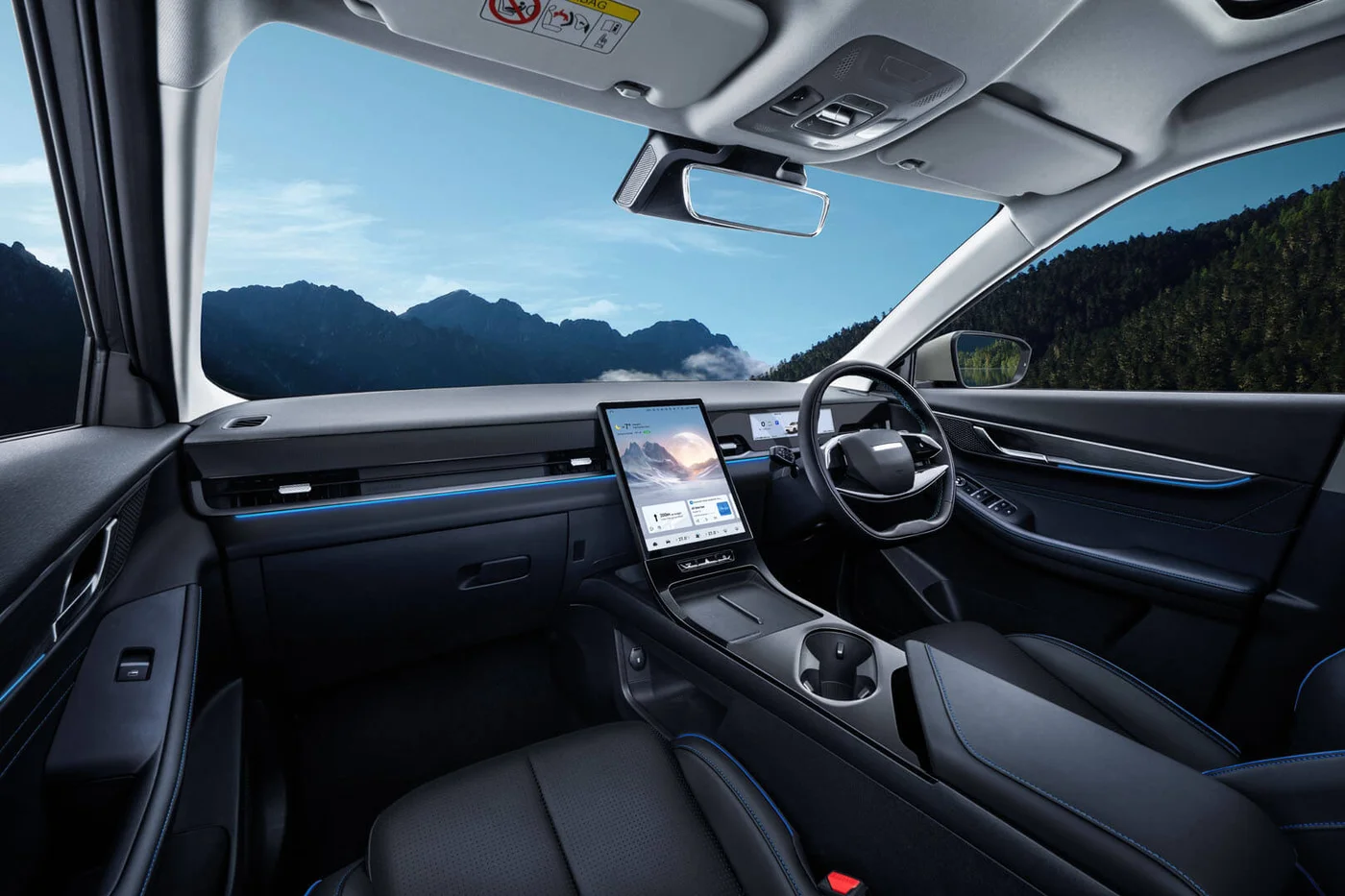
The screen is quick and no tester reported lag. Phone mirroring works particularly well in portrait, with maps filling the top half. Nearly everything else lives in it too. Fan speed, temperature, regen level, mirror adjustment and the driver-assist settings are all screen menus, and the climate bar disappears while CarPlay or Android Auto is running until you swipe up from the bottom edge. Only the drive-mode, hazard and lock buttons are physical, and this is the most common complaint about the car.
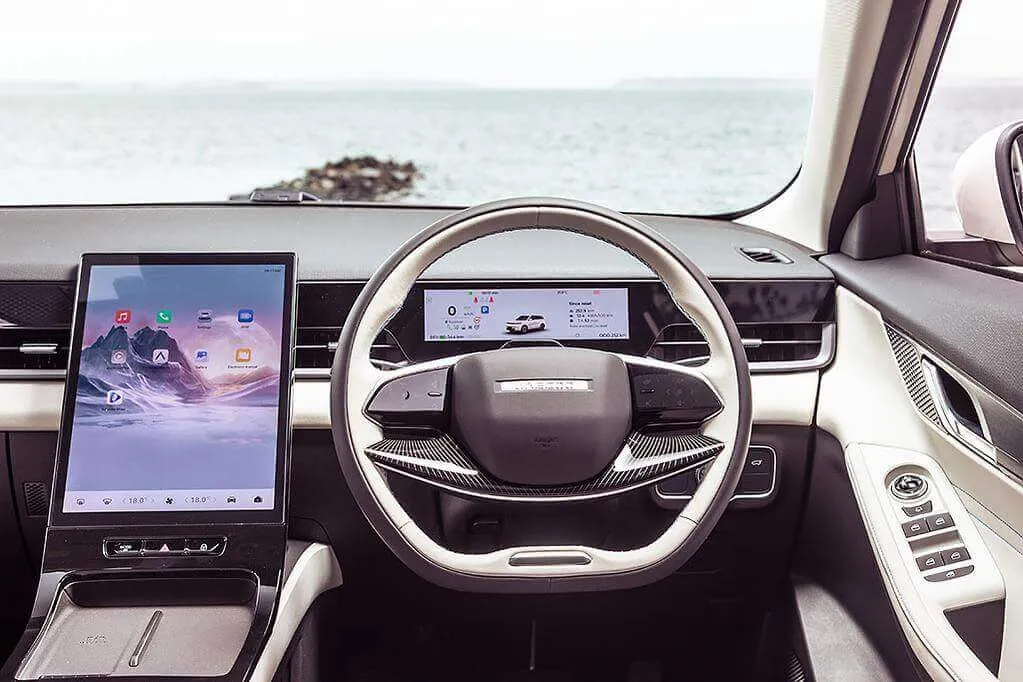
The voice assistant handles the sunshade, windows and seat ventilation well but has mixed up contact names when placing calls. The driver display is small and plain next to the main screen, the steering-wheel touch buttons are hard to find until they light up, and the eight-speaker system sounds thin at the bottom end.
Range, battery & charging
Real-world range7.0
Nepali testers have recorded about 12 to 13 kWh per 100 km in Kathmandu traffic and 13 to 14 kWh per 100 km on the Koteshwor to Dhulikhel road. On a steep, loose-gravel climb to Chitlang, the J5 Pro used 17 to 19 kWh per 100 km. Overseas, week-long tests of the 58.9 kWh car settled at about 15 kWh per 100 km in mixed driving, with one open-road test never dropping below 19.
For the J5, that means a little over 400 km in the valley, about 370 km on a typical mixed week and 300 to 330 km on a day of hard climbing. The J5 Pro manages about 340 km in mixed use and up to around 400 km in gentle city driving. Owners report figures in the same range. The J5's mixed figure is close to the larger-battery MG S5 and ahead of the Atto 2 and B03X, while the Pro lands around the B03X.
Battery8.0
Both trims use CATL lithium iron phosphate cells, which tolerate daily charging to 100 percent and are less prone to thermal runaway than nickel-based packs. The J5's 58.9 kWh pack is larger than the batteries in the Atto 2, the B03X and the smaller MG S5. The manufacturer's warranty covers the battery for eight years or 180,000 km and the motor for eight years or 160,000 km.
- Battery
- 50.6 kWh LFP
- Range (NEDC)
- 405 km
- Motor
- 155 kW, 288 Nm, front
- DC peak
- 130 kW
- DC 30-80%
- 28 min
- AC on-board charger
- 6.6 kW
- Spare wheel
- Space-saver
- Battery
- 58.9 kWh LFP
- Range (NEDC)
- 461 km
- Motor
- 155 kW, 288 Nm, front
- DC peak
- 130 kW
- DC 30-80%
- 28 min
- AC on-board charger
- 6.6 kW
- Spare wheel
- Full-size alloy
Efficiency and running cost7.0
At about 15 kWh per 100 km in mixed use the J5 is average for its class. The Atto 2 uses less energy on the same kind of roads, especially at highway speeds, where the J5's tall, square body costs it.
SPG offers an extension that takes battery cover to 11 years or 240,000 km and motor cover to 11 years or 200,000 km. It comes with conditions: it is issued through insurance, it lapses if the owner leaves the nominated insurer, and the car must be serviced at authorised workshops. Service intervals are every 10,000 km or 12 months. SPG has not published a whole-vehicle warranty figure that we could confirm.
Charging6.0
Both trims accept up to 130 kW on DC, and Jaecoo claims 30 to 80 percent in 28 minutes. That peak is higher than the Atto 2's, but the claimed time is slow for the class: the Deepal S05, Nevo Q05 and B03X all claim 30 to 80 percent in 15 or 16 minutes. No Nepali tester has timed a full DC session yet, and one overseas test in cool weather saw a peak of about 100 kW. Most public DC chargers in Nepal deliver 60 kW or less. On a 60 kW unit the same top-up takes a little over half an hour, and on a 30 kW unit about an hour.
The on-board AC charger is rated at 6.6 kW, enough for a full charge overnight on a home wallbox.
Charging availability7.0
SPG runs or partners on about 20 chargers, with DC units in Kathmandu, Pokhara, Kurintar, Narayanghat, Butwal, Nepalgunj, Birgunj, Itahari, Birtamode and on the BP Highway at Sindhuli. That is a useful spread along the main corridors, but the brand's DC units top out at 30 kW, so the J5's 130 kW peak only pays off at higher-power NEA or private stations. A free 7 kW home charger was part of the launch offer, so check whether it is still included. BYD's own and partner network offers faster units along more routes.
Performance & driving
Performance and hill climbing7.0
The 155 kW front motor is stronger than those in the Atto 2, MG S5 and B03X, and Jaecoo claims 0 to 100 km/h in 7.7 seconds. Eco mode is enough for city driving and highway overtakes, and Sport sharpens the response noticeably. On tarmac climbs it pulls without effort with a full load.
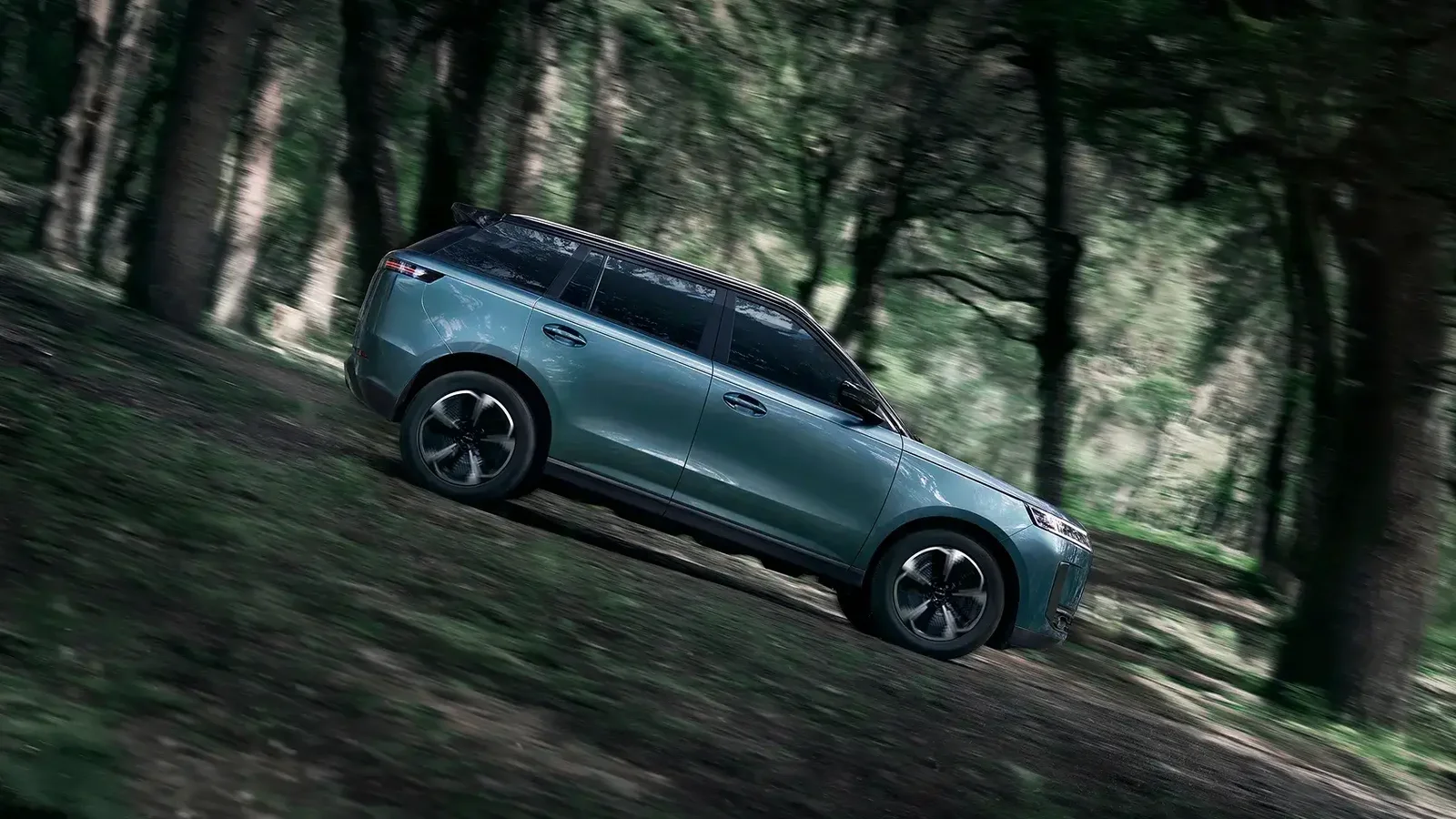
Traction is the weak point. With 288 Nm through the front wheels, testers saw wheelspin and some torque steer on wet roads, red clay, stone paving and loose gravel, even in Eco, and the traction control steps in late. On the stock tyres it struggled on parts of one steep hill, and a heavy right foot makes the wheelspin worse on loose surfaces. Regen comes in three levels, set only in the screen, with no one-pedal mode. The highest level hesitates for a moment after you lift off, then pulls hard, so most drivers use the low or middle setting. Hill-descent control works between 3 and 60 km/h, and on loose gravel downhill regen recovered very little.
Driving experience, ride and handling7.0
The J5 corners more keenly than most rivals, with tidy body control and a sharp turn-in, though the MG S5 is still the more polished car to drive. The steering is light and suits town driving, but it gives little sense of grip, and the Sport setting adds weight more than feel. The cabin is very quiet thanks to acoustic glass, apart from rumble on stone-paved roads.
The ride leans firm. It does not sag with a full load, it stays settled at highway speed, and it handles ordinary potholes well. Sharp edges, broken stones and paved village roads come through more clearly than in the softer B03X. Two habits take some learning: the gear stalk sits where many drivers expect the indicator, and the car will not move in Drive with the driver's belt unbuckled, which is tiresome when shuffling it in a tight parking space.
Road tolerance7.0
Ground clearance of 185 mm, short overhangs and approach and departure angles of 20 and 29.8 degrees let the J5 clear speed breakers, steep driveways and rough construction diversions without scraping. Jaecoo quotes a 450 mm wading depth. The spare wheel is a real advantage on remote roads. Front-wheel drive and the stock tyres are the limit on muddy or loose climbs, and sharp stones rattle through the cabin.
Safety & build
Safety7.0
Both trims carry six airbags, stability control, roll stability control, rear parking sensors and the 540-degree camera, along with a long driver-assist list. It covers adaptive cruise with traffic-jam assist, lane-keep and lane-centring assist, autonomous emergency braking, blind-spot monitoring, rear cross-traffic alert with braking, emergency lane keeping, door-opening warning and a driver-fatigue reminder.
The camera is one of the clearest in the class. The rest of the driver-assist systems work, but in Kathmandu traffic the forward collision warning chimes constantly and adaptive cruise is little use without lane discipline, so most Nepali drivers will switch much of it off. The J5 EV has not been crash-tested by Euro NCAP, ANCAP or ASEAN NCAP, though Jaecoo says it is aiming for five stars.
Build quality and reliability7.0
Build quality is good for the class, and better on 2026 cars than on the first batch. Test cars have shown small faults: slow rain-sensing wipers, a flimsy key fob, an interior light that would not switch off, a false door-ajar warning and, on one overseas car, a powered charge flap that stopped sealing. No recalls have been issued for the J5 EV. It shares its underpinnings with the Omoda E5, but the model is new everywhere, so there is no long-term record yet.
Value & ownership
Price and value8.0
The J5 Pro is the stronger buy. It has every feature of the J5, including 130 kW DC charging, ventilated seats, the glass roof, the powered tailgate and the 540-degree camera, and loses only battery capacity and the full-size spare. Few cars at its price come this well equipped, and none of its direct rivals looks as distinctive. The J5 costs a fair amount more for its extra 8.3 kWh, which only makes sense for owners who regularly drive out of the valley. Resale values for a brand this new are still unknown.
After-sales and service network7.0
SPG lists 13 service centres: Sitapaila in the valley, plus Bhaktapur, Pokhara, Butwal, Narayanghat, Birgunj, Biratnagar, Itahari, Birtamode, Dang, Nepalgunj, Dhangadhi and Surkhet. That is wider coverage than Leapmotor or Deepal offer, and the Pokhara site is a large sales, service and spares facility. We found no reports of poor service, though spare-parts supply has had little time to be tested. The extended battery warranty's link to one insurer is worth weighing before you sign.
Editor's opinion8.0
The J5 Pro is one of the best-equipped and best-looking cars in its class, and its workshop network reaches further than most new brands manage. The BYD Atto 2 uses less energy, has proper climate buttons and is backed by BYD's faster charging network, but the J5 Pro has a stronger motor and more equipment. For a buyer who drives mostly on tarmac, we would pick the J5 Pro.
Verdict
The Jaecoo J5 combines a distinctive square-cut design with a generous equipment list, a quiet cabin and a strong 155 kW motor, and both trims get 130 kW DC charging. Real-world range runs from about 340 km in the J5 Pro to about 370 km in the J5 on a mixed week, which covers most Nepali routines, while efficiency is only average. Its weaknesses show in daily use: too many controls inside the touchscreen, a jerky top regen setting, a firm ride over sharp stones and front tyres that spin easily on loose climbs. SPG's 13 service centres cover most of the country, but its own DC chargers are slow and the extended warranty is tied to one insurer. Against its rivals it gives up some efficiency and ride comfort for more power, more equipment and a design that stands out.
Good
A distinctive, generously equipped compact SUV with 130 kW charging on both trims, held back by touchscreen-only climate controls and front tyres that spin easily on loose climbs.
Kushal Rajbhandari
Oct 25, 2026
A distinctive, generously equipped compact SUV with 130 kW charging on both trims, held back by touchscreen-only climate controls and front tyres that spin easily on loose climbs.
Kushal Rajbhandari
Oct 25, 2026
FAQ
What is the difference between the Jaecoo J5 and the J5 Pro?
Only the battery, the range and the spare wheel. The J5 Pro, the cheaper trim, has a 50.6 kWh battery, a claimed 405 km and a space-saver spare. The J5 has a 58.9 kWh battery, a claimed 461 km and a full-size spare. Motor, charging and equipment are identical.
How much real-world range does the Jaecoo J5 get in Nepal?
The J5 gets a little over 400 km in valley driving, about 370 km in mixed use and 300 to 330 km on a day of steep climbs. The J5 Pro gets about 340 km in mixed use and up to around 400 km in gentle city driving.
Does the J5 Pro support DC fast charging?
Yes. Both trims accept up to 130 kW on DC, with a claimed 30 to 80 percent top-up in 28 minutes. On the 60 kW chargers common in Nepal, the same top-up takes a little over half an hour, and about an hour on SPG's own 30 kW units.
Is the Jaecoo J5 good on bad roads and hills?
It has 185 mm of ground clearance, short overhangs and a spare wheel, and it climbs tarmac hills easily. As a front-wheel-drive car on road tyres it spins its wheels on loose gravel, mud and wet stone, so it is not suited to rough trails.
What warranty does the Jaecoo J5 come with?
The battery is covered for eight years or 180,000 km and the motor for eight years or 160,000 km. SPG's extension raises this to 11 years or 240,000 km for the battery and 11 years or 200,000 km for the motor, provided the car stays insured with the nominated insurer and is serviced at authorised workshops.
Where can I service a Jaecoo J5 outside Kathmandu?
SPG lists service centres in Bhaktapur, Pokhara, Butwal, Narayanghat, Birgunj, Biratnagar, Itahari, Birtamode, Dang, Nepalgunj, Dhangadhi and Surkhet, as well as Sitapaila in the valley.
Does the Jaecoo J5 have a crash-safety rating?
No. The J5 EV has not been tested by Euro NCAP, ANCAP or ASEAN NCAP. It has six airbags and a full suite of driver-assist systems, including autonomous emergency braking.