

Yatri P2 Priced From Rs 3.29 Lakh, Deliveries Begin Mid-October

EV Nepal
· Sep 18, 2026
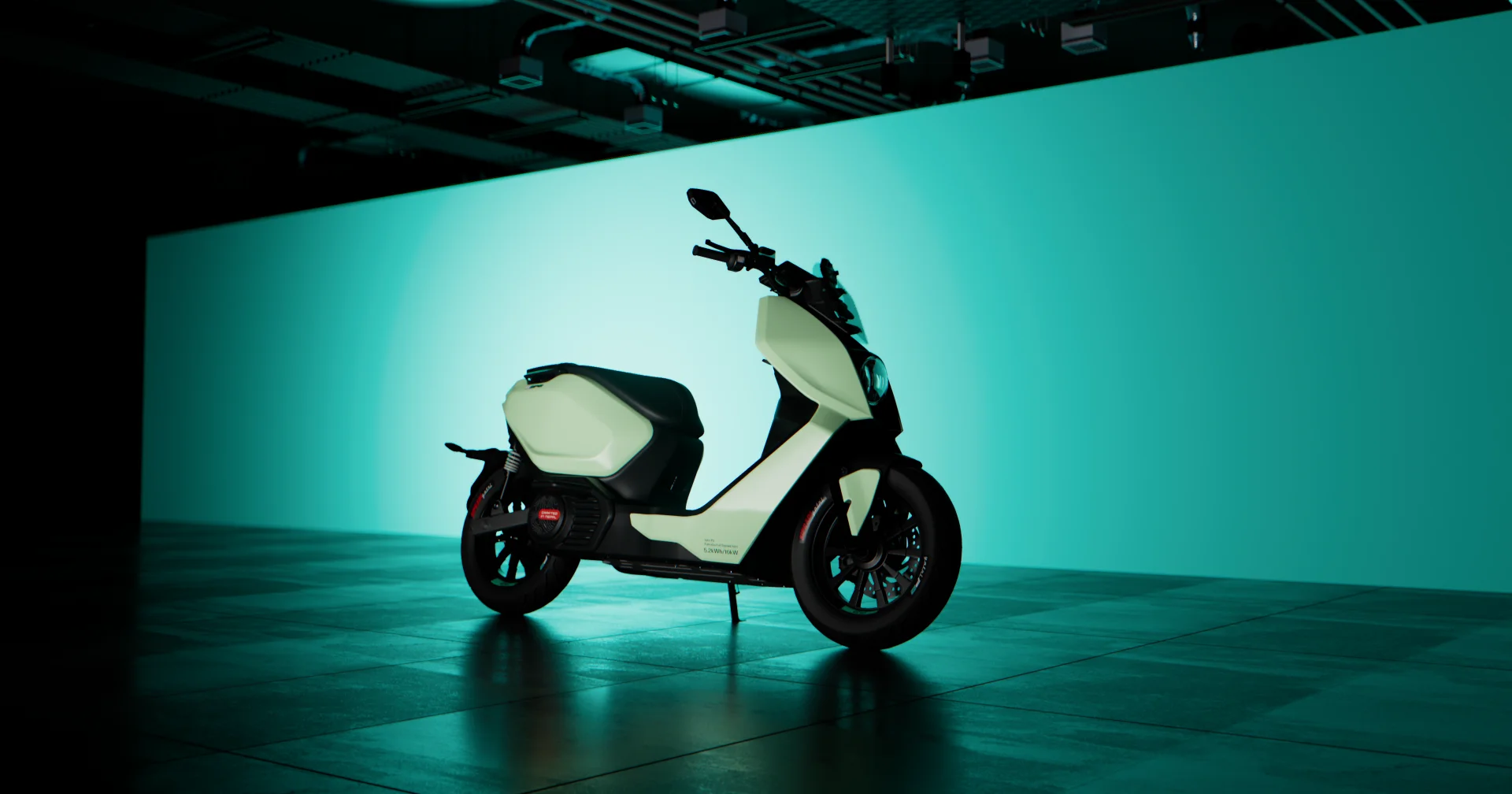
Yatri Motorcycles has revealed pricing for the P2 and opened the configurator, closing the three-week gap the company left open after unveiling the scooter at the NADA Auto Show in late August.
Three power packs, each with its own motor output and claimed range:
| Power pack | Motor | Range | Price | Deliveries |
|---|---|---|---|---|
| 3.0 kWh | 6 kW | 90 km | Rs 3,29,900 | December |
| 3.7 kWh | 8 kW | 112 km | Rs 3,99,900 | Mid-October |
| 5.2 kWh | 10 kW | 157 km | Rs 4,99,900 | Mid-October |
A 1.8 kWh range extender, worth a claimed 50 km, is Rs 90,600. A rapid home charger is Rs 29,000.
The base price is a starting point
The more interesting thing about the reveal is the configurator behind it. Yatri has not built the P2 as three fixed trims. It has built it as a base vehicle with a list of paid options, closer to how Tesla and Ather sell than how scooters are normally sold in Nepal.
On the Rs 3,29,900 entry car — the 3.0 kWh pack — the following are extras:
| Option | Price |
|---|---|
| Standard Connectivity | Rs 19,200 |
| Michelin tyres | Rs 16,000 |
| Dash Pack | Rs 5,650 |
| Cruise control | Rs 5,000 |
| Premium mirrors | Rs 3,480 |
| Regen tail light | Rs 2,500 |
| Premium handlebar grip | Rs 960 |
Tick all of them and the entry P2 is Rs 3,82,690 before the range extender or the home charger. Add both and it is Rs 5,02,290 — more than a base 5.2 kWh.
Connectivity is the item worth watching. The 3.0 kWh pack ships without it; Standard Connectivity, which Yatri describes as core telematics with the tracker included, is the Rs 19,200 add-on. The 3.7 kWh includes Standard Connectivity in its price. The 5.2 kWh includes Advanced Connectivity — the full telematics suite with the anti-theft pack.
So the gap between the packs is not only battery and motor. Buyers comparing the three will need to read what each one already has before the Rs. 70,000 steps between them make sense.
Above what the market expected
The numbers land higher than most pre-launch estimates. Ahead of the reveal, coverage across Nepali tech and auto outlets had converged on a Rs 3 lakh to Rs 4 lakh band, with projections of roughly Rs 3 lakh for the entry pack and just under Rs 4 lakh for the top one. Every variant has come in above those figures, and the 5.2 kWh a full lakh above.
That puts the P2 at the top of Nepal's electric two-wheeler market rather than in the middle of it. Most of the imported Chinese and Indian electric scooters launched here this year — Yadea's GS70, GT80 and GT70, Hero's VIDA VX2 — sit well below the P2's entry price, and far below its top variant.
Yatri's argument for the gap is the hardware and the network. Whether buyers accept it is the open question, and the booking numbers over the next few weeks will answer it faster than any spec sheet.
What you get
The P2 uses a mid-drive PMSM motor, stepped by pack: 6 kW on the 3.0 kWh with a 340A controller, 8 kW on the 3.7 kWh and 10 kW peak on the 5.2 kWh, both on a 450A controller. Yatri rates the 10 kW at 315 Nm at the wheel. Top speed is 90 km/h. Cells are supplied by LG.
Claimed city range runs from 90 km to 157 km across the three packs. The 1.8 kWh range extender adds 50 km, taking the top variant to the 207 km figure Yatri has been quoting since NADA.
Charging: a 1,350 W onboard AC charger across all three packs, taking the battery to 80 percent in under two and a half hours, and DC fast charging to 80 percent in 41 minutes.
Warranty is 3 years or 30,000 km on the vehicle, whichever comes first. Battery cover is 5 years or 50,000 km as standard, with 6-year and 8-year extensions offered depending on configuration.
The chassis is a dual-cradle trellis frame on 14-inch alloys, with 90 mm of front fork travel and dual progressive rear shocks. Braking is a 240 mm front and 220 mm rear ventilated disc setup with combined braking. Kerb weight is 140 kg, seat height 775 mm, boot space 30 litres.
Six finishes are offered at the same price, all named after Nepali geography: Mustang Desert, Everest Snow, Sauraha Mist, Annapurna Storm, Chure Thunder and Kalapatthar Midnight.
The charging network
Alongside pricing, Yatri has published the Phase-I layout of its own charging network: 35 charging stations across 15 destinations, organised as four corridors radiating out of Kathmandu.
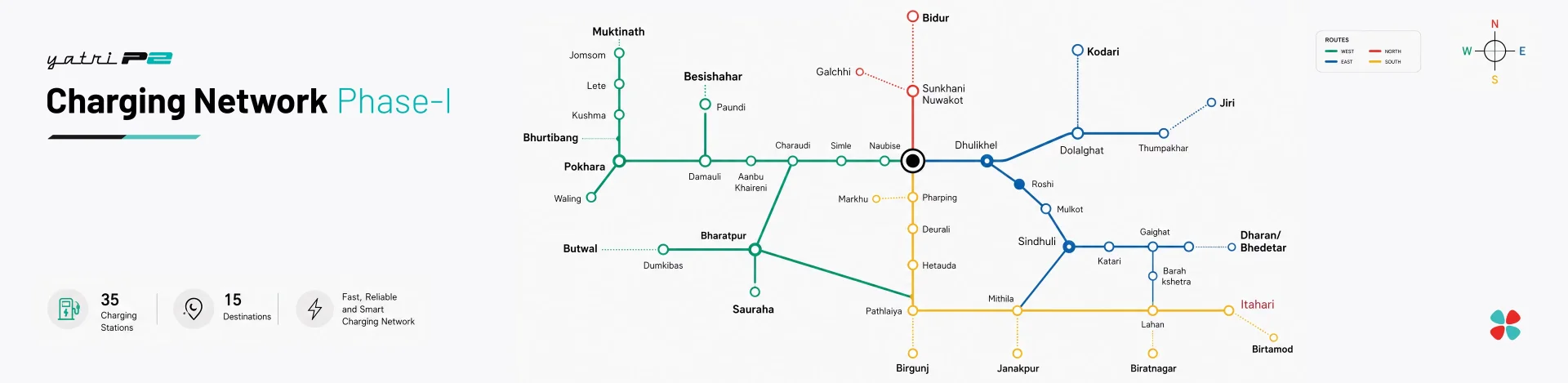
West runs the Prithvi Highway through Naubise, Simle, Charaudi, Aanbu Khaireni and Damauli to Pokhara, then climbs north via Kushma, Lete and Jomsom to Muktinath. Spurs reach Besishahar via Paundi, plus Waling and Bhurtibang. A second western leg drops through Bharatpur to Sauraha and along to Dumkibas and Butwal.
North is the shortest leg — Sunkhani Nuwakot to Bidur, with a spur to Galchhi.
East splits at Dhulikhel. One arm goes to Dolalghat and on to Kodari, with a branch through Thumpakhar to Jiri. The other runs the Sindhuli road through Roshi and Mulkot to Sindhuli, then Katari and Gaighat to Dharan and Bhedetar, with a Barahkshetra spur.
South heads down through Pharping, Deurali and Hetauda to Pathlaiya and Birgunj, with a Markhu spur, then east along the Terai to Mithila, Janakpur, Lahan, Biratnagar, Itahari and Birtamod.
Two things stand out. The first is Jomsom and Muktinath — putting fast charging at that altitude, on that road, is a harder problem than anything on the Terai, and no other network in Nepal has attempted it. The second is what is missing: Phase-I stops at Bhurtibang and Butwal in the west. Nepalgunj, Dhangadhi and the whole Sudurpaschim corridor are not on this map.
Why it matters
Nepal's electric two-wheeler segment is growing quickly but from a small base. In the Kathmandu valley, electric two-wheelers accounted for 10,374 of 98,727 new registrations in FY 2025/26 — 10.51 percent, up from 6.4 percent the year before, according to the Transport Management Office at Gurjudhara.
Almost all of that volume is imported. The P2 is the most serious attempt yet to build a competitive electric two-wheeler in Nepal, and it is being priced as a premium product rather than a patriotic discount. If it sells at these numbers, it changes what a made-in-Nepal vehicle can credibly ask for.
If it doesn't, the constraint will not have been the engineering.