

NEA Electricity Tariff 2026: New 5% VAT, Residential Rates & EV Charging Costs Explained

Kushal Rajbhandari
· Jul 18, 2026
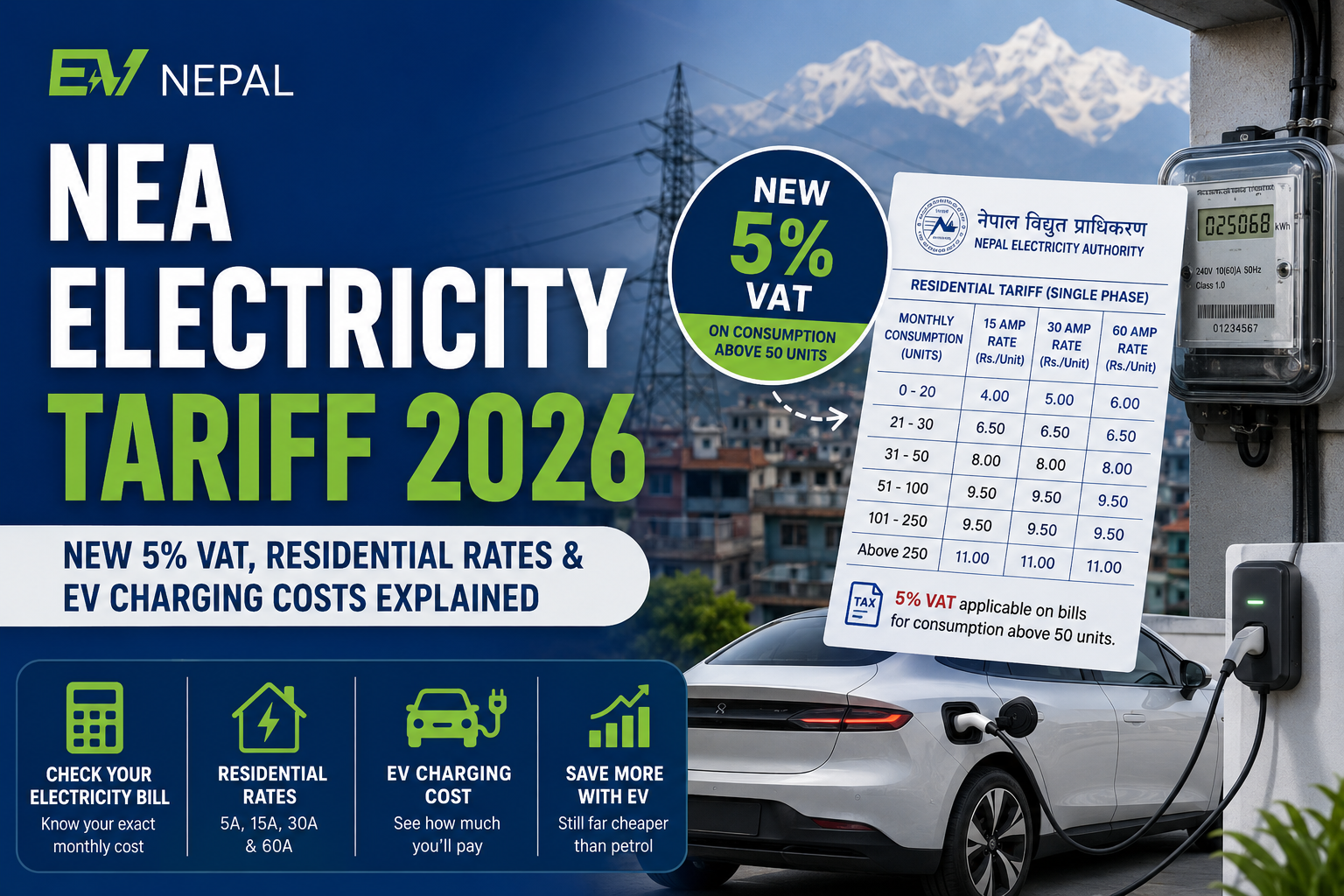
NEA Electricity Tariff 2026: New 5% VAT, Residential Rates & EV Charging Costs Explained
If you've heard that electricity has become more expensive after the FY 2083/84 (2026/27) budget, the answer is yes—but not because the Nepal Electricity Authority (NEA) increased its tariff.
Instead, the Government has introduced a 5% Value Added Tax (VAT) on residential electricity bills for households consuming more than 50 units (kWh) per month. While the electricity tariff itself remains unchanged, many households—including most electric vehicle (EV) owners—will notice a small increase in their monthly electricity bills.
The good news? Charging an EV at home remains significantly cheaper than driving a petrol or diesel vehicle.
In this guide, we'll cover:
- What's changed in the new fiscal year
- The latest NEA residential electricity tariff
- How electricity bills are calculated
- How progressive slab billing works
- What the new VAT means
- How much it costs to charge an EV
- Which meter size is suitable for EV charging
Quick Summary
In Short
- ✅ NEA has not increased electricity tariffs.
- ✅ A 5% VAT has been introduced through the FY 2083/84 budget.
- ✅ Households consuming more than 50 units/month will see a slightly higher bill.
- ✅ Most EV owners are likely to exceed 50 units each month.
- ✅ Even after VAT, home charging remains far cheaper than petrol or diesel.
What Changed in FY 2083/84?
The Government of Nepal has introduced a 5% VAT on residential electricity consumption exceeding 50 units per month.
This is not a tariff revision by NEA.
The electricity rates remain exactly the same as before. The only change is the addition of VAT under the new fiscal year's budget.
If your monthly consumption is 50 units or less
- No VAT
- Electricity bill remains unchanged
If your monthly consumption exceeds 50 units
- Existing electricity tariff still applies
- 5% VAT is added according to the government's new tax policy
Note: Before relying on any calculator or worked examples, verify how NEA applies the new VAT in its billing system (for example, whether it applies to the entire taxable amount or only specific bill components), as implementation should follow the latest official guidance.
How Your Electricity Bill is Calculated
Your monthly electricity bill consists of several components:
- Monthly service charge (minimum charge)
- Energy charge
- Electricity duty (where applicable)
- VAT (where applicable)
- Other statutory charges
Your bill depends on:
- Monthly electricity consumption
- Meter capacity (5A, 15A, 30A or 60A)
Latest NEA Residential Electricity Tariff (Single Phase – 230V)
5 Ampere Meter
| Monthly Consumption | Service Charge | Energy Charge |
|---|---|---|
| 0–20 units | Rs. 30 | Free |
| 21–30 units | Rs. 50 | Rs. 6.50/unit |
| 31–50 units | Rs. 50 | Rs. 8.00/unit |
| 51–100 units | Rs. 75 | Rs. 9.50/unit |
| 101–250 units | Rs. 100 | Rs. 9.50/unit |
| Above 250 units | Rs. 150 | Rs. 11.00/unit |
15 Ampere Meter
| Monthly Consumption | Service Charge | Energy Charge |
|---|---|---|
| 0–20 units | Rs. 50 | Rs. 4.00/unit |
| 21–30 units | Rs. 75 | Rs. 6.50/unit |
| 31–50 units | Rs. 75 | Rs. 8.00/unit |
| 51–100 units | Rs. 100 | Rs. 9.50/unit |
| 101–250 units | Rs. 125 | Rs. 9.50/unit |
| Above 250 units | Rs. 175 | Rs. 11.00/unit |
30 Ampere Meter
| Monthly Consumption | Service Charge | Energy Charge |
|---|---|---|
| 0–20 units | Rs. 75 | Rs. 5.00/unit |
| 21–30 units | Rs. 100 | Rs. 6.50/unit |
| 31–50 units | Rs. 100 | Rs. 8.00/unit |
| 51–100 units | Rs. 125 | Rs. 9.50/unit |
| 101–250 units | Rs. 150 | Rs. 9.50/unit |
| Above 250 units | Rs. 200 | Rs. 11.00/unit |
60 Ampere Meter
| Monthly Consumption | Service Charge | Energy Charge |
|---|---|---|
| 0–20 units | Rs. 125 | Rs. 6.00/unit |
| 21–30 units | Rs. 125 | Rs. 6.50/unit |
| 31–50 units | Rs. 125 | Rs. 8.00/unit |
| 51–100 units | Rs. 150 | Rs. 9.50/unit |
| 101–250 units | Rs. 200 | Rs. 9.50/unit |
| Above 250 units | Rs. 250 | Rs. 11.00/unit |
Understanding Progressive Slab Billing
One of the biggest misconceptions about NEA's electricity tariff is that once your consumption reaches a higher slab, every unit is billed at that slab's rate.
That is not how NEA calculates electricity bills.
Instead, NEA follows a progressive slab system, where each block of units is billed separately.
Example: 120 Units on a 15A Meter
| Units | Rate |
|---|---|
| First 20 units | Rs. 4.00/unit |
| Next 10 units | Rs. 6.50/unit |
| Next 20 units | Rs. 8.00/unit |
| Remaining 70 units | Rs. 9.50/unit |
Only the last 70 units are billed at Rs. 9.50. The earlier units continue to be charged at their lower rates.
This is why your effective cost per unit is usually lower than the highest slab rate.
What Does the New VAT Mean?
For most households, the impact is relatively small.
| Monthly Bill | Approx. 5% VAT |
|---|---|
| Rs. 500 | Rs. 25 |
| Rs. 1,000 | Rs. 50 |
| Rs. 2,000 | Rs. 100 |
| Rs. 3,000 | Rs. 150 |
The electricity tariff itself has not changed.
The increase comes from the new tax introduced through the national budget.
How Much Does It Cost to Charge an EV?
One of the biggest benefits of owning an EV is the low cost of home charging.
Below are approximate monthly electricity requirements if the battery is fully charged once every week.
| Battery Size | Approx. Monthly Electricity |
|---|---|
| 19.2 kWh | ~77 units |
| 24 kWh | ~96 units |
| 30 kWh | ~120 units |
| 35 kWh | ~140 units |
| 40 kWh | ~160 units |
| 45 kWh | ~180 units |
| 50 kWh | ~200 units |
| 60 kWh | ~240 units |
Even with the new VAT, home charging remains one of the most affordable ways to power a vehicle.
Petrol vs EV Running Cost
Although electricity bills may increase slightly, the difference compared to petrol remains substantial.
| Vehicle Type | Approximate Running Cost |
|---|---|
| Petrol Hatchback | Rs. 10–12/km |
| Diesel SUV | Rs. 8–10/km |
| Home-Charged EV | Rs. 1.5–2.5/km |
For most EV owners, the additional VAT amounts to only a small fraction of the monthly fuel savings.
Do You Need a Bigger Meter?
Most households in Nepal have either a 15A or 30A connection.
A 15A or 30A meter is generally sufficient for:
- Portable EV chargers
- Overnight charging
- Typical household appliances
You may want to consider upgrading if your home has:
- A dedicated 7 kW wall charger
- Multiple air conditioners
- Electric cooking
- Electric water heating
- Several high-power appliances running simultaneously
Calculate Your Electricity Bill
Rather than calculating everything manually, use our NEA Electricity Bill Calculator.
Simply enter:
- Monthly electricity consumption
- Meter size
- VAT applicability
The calculator will instantly estimate:
- Energy charge
- Service charge
- VAT
- Total payable amount
It can also estimate the cost of charging your EV at home.
Frequently Asked Questions
Has NEA increased electricity tariffs?
No. NEA's residential tariff remains unchanged. The increase comes from the new 5% VAT introduced through the FY 2083/84 budget.
Does everyone have to pay VAT?
No. Households consuming 50 units or less remain exempt.
Is charging an EV still cheaper than petrol?
Yes. Even after the new VAT, home charging remains significantly more economical than fueling a petrol or diesel vehicle.
Which meter is best for an EV?
Most households can comfortably charge an EV with a 15A or 30A meter. Homes with larger chargers or multiple heavy electrical appliances may require a higher-capacity connection.
Final Thoughts
The FY 2083/84 budget introduces a new 5% VAT on certain residential electricity bills, but NEA has not increased its electricity tariff.
For households consuming more than 50 units each month—including many EV owners—the monthly bill will increase slightly due to the new tax. However, electricity remains one of Nepal's most affordable energy sources, and charging an EV at home continues to cost only a fraction of running a petrol or diesel vehicle.
Understanding how NEA's tariff, meter sizes, and progressive billing system work can help you better estimate your monthly electricity costs and make informed decisions about your energy usage.
Try Our NEA Electricity Bill Calculator
Use our interactive calculator to estimate your monthly electricity bill based on your meter size, electricity consumption, and the latest tariff structure.
You can also estimate the cost of charging your electric vehicle at home and compare it with the cost of driving a petrol or diesel vehicle.