

Why Are Cars So Expensive in Nepal?
EV Nepal
· Dec 1, 2025
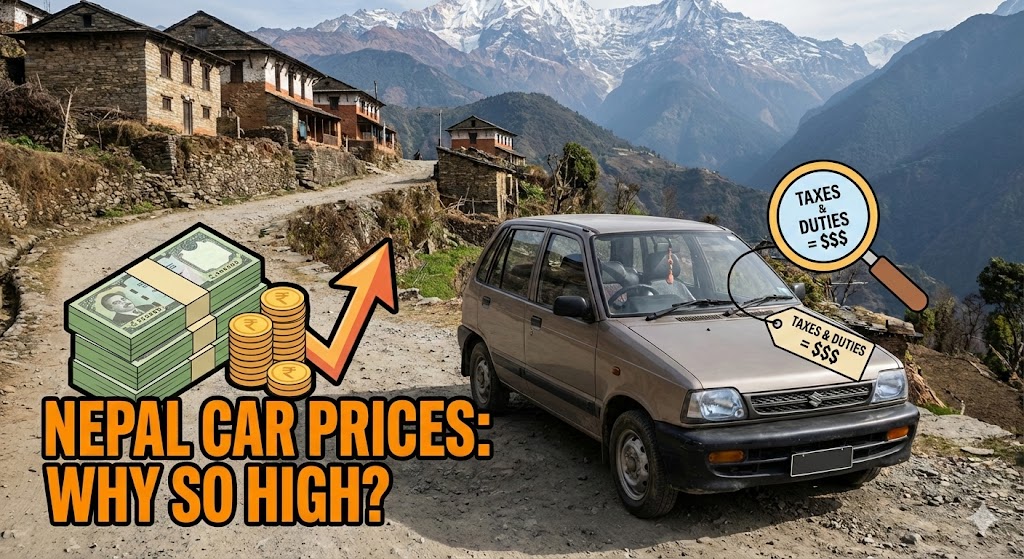
If you have ever crossed the border into India or looked up car prices online, you are probably shocked at the actual prices of the car. A car that costs INR 10 Lakhs (approx. NPR 16 Lakhs) in India often ends up with a price tag of NPR 40 to 50 Lakhs in Nepal.
Why is there such a massive difference? Why do we pay nearly three times the actual value of a vehicle?
The answer lies in a complex web of government policies, heavy taxation, and logistical challenges. In this article, we break down exactly where your money goes when you buy a car in Nepal and compare the stark difference between Petrol/Diesel cars and Electric Vehicles (EVs).
The Main Culprit: 250% Tax Structure
In Nepal, private automobiles are categorized not as necessities, but as "luxury goods." This classification allows the government to impose some of the highest import taxes in the world. For internal combustion engine (ICE) vehicles, those running on petrol or diesel, the tax burden is staggering.
Here is a breakdown of the taxes levied on a typical petrol car:
- Customs Duty (80%): This is the base tax applied to the invoice value of the car.
- Excise Duty (60% - 100%): Based on the engine capacity (CC), this tax is added on top of the customs-paid value.
- VAT (13%): Value Added Tax is calculated on the total value after Customs and Excise duties are added, compounding the cost further.
- Road Construction & Maintenance Tax (up to 10%): A one-time tax collected at the time of registration.
The Tax Multiplier Effect
It is not just simple addition; it is multiplication. VAT is charged on the cumulatively taxed amount, meaning you pay tax on tax.
Hypothetical Calculation for a Petrol Car (1200cc):
| Cost Component | Amount (NPR) | Notes |
|---|---|---|
| Invoice Price (CIF) | 1,000,000 | Cost + Insurance + Freight to Nepal border |
| + Customs Duty (80%) | 800,000 | |
| Subtotal | 1,800,000 | |
| + Excise Duty (Assume 60%) | 1,080,000 | Calculated on Invoice Value (varies by bracket) |
| Taxable Value for VAT | 2,880,000 | Note: Excise calculation base can vary slightly by rule changes |
| + VAT (13%) | 374,400 | Charged on the aggregated value |
| Landed Cost | 3,254,400 | Already 3.2x the original price! |
Note: This is a simplified estimation. Actual calculations involve specific HSN codes and varying excise slabs.
By the time distributor margins (overhead, marketing, showroom costs, profit) and road taxes are added, the final price for the consumer easily crosses NPR 40 Lakhs for a car that cost NPR 10 Lakhs to import.
Other Contributing Factors
While taxes are the biggest chunk, other factors drive up prices:
- Landlocked Geography: Nepal has no sea port. Cars imported from third countries (Japan, Korea, Europe) must land in Kolkata or Visakhapatnam in India and be transported by road or rail. This adds significant freight, insurance, and handling costs.
- Dealer Margins & Overhead: Operating a dealership in Nepal is expensive due to high real estate costs, bank interest rates, and the risk of holding stock. Dealers add a margin to cover these operational costs and secure a profit.
- Exchange Rate Fluctuations: Since Nepal imports all its vehicles, any weakening of the Nepali Rupee against the Dollar or other currencies directly increases the import cost.
The Comparison: Petrol vs. Electric Vehicles (EVs)
This is where the story changes completely. In an effort to reduce reliance on imported fossil fuels and utilize domestically produced hydroelectricity, the Nepal government has adopted a much softer stance on EVs.
While taxes on EVs have increased slightly in recent budgets, they remain a fraction of what petrol cars face.
EV Tax Advantage (Fiscal Year 2082/83)
For the fiscal year 2082/83 (2025/26), the government has maintained a tiered tax structure for electric vehicles based on motor power (kW). Here are the actual tax slabs:
| Motor Power (kW) | Customs Duty | Excise Duty |
|---|---|---|
| Up to 50 kW | 15% | 5% |
| 51 - 100 kW | 20% | 15% |
| 101 - 200 kW | 30% | 20% |
| 201 - 300 kW | 40% | 35% |
| 300+ kW | 60% | 60% |
Source: Department of Customs, Nepal
This progressive tax system means smaller, more efficient city cars pay significantly less tax than high-performance luxury EVs. Even at the highest bracket, the total tax burden is often lower than that of a comparable petrol SUV.
Price Comparison: BYD Atto 3 (Nepal, India and China)
To see how this plays out in the real world, let us look at the BYD Atto 3, one of the most popular electric SUVs in Nepal.
| Market | Price (Approx.) | Equivalent NPR |
|---|---|---|
| China | CNY 119,800 | ~ NPR 22 Lakhs |
| India | INR 25 Lakhs (Ex-showroom) | ~ NPR 40 Lakhs |
| Nepal | NPR 56.9 Lakhs | NPR 56.9 Lakhs |
Note: Prices are for the base/advanced variants and are subject to change.
Why is the Nepal price still higher than India or China? Even though EV taxes are lower than petrol taxes, they still add up.
- Cumulative Taxes: On a 100 kW EV like the Atto 3 Advanced, you pay 20% Customs + 15% Excise + 13% VAT + Road Tax. This adds roughly 50-60% to the base cost.
- Logistics: Shipping a car from China to Nepal involves sea freight to Kolkata and road transport to the border, which is expensive.
- Economies of Scale: In China and India, cars are often manufactured locally, avoiding import duties. Nepal imports fully built units (CBU), which are always more expensive.
Despite this, the Atto 3 at ~57 Lakhs is competing against petrol SUVs like the Hyundai Creta or Kia Seltos, which can cost upwards of 70-80 Lakhs for top-spec variants in Nepal. This value proposition is why EVs are winning.
Conclusion
Cars are expensive in Nepal primarily because the government treats them as a luxury revenue stream rather than a mode of transport. For every rupee you spend on the car itself, you are often paying two or three rupees to the government.
However, the market is shifting. The tax incentives for Electric Vehicles have created a unique loophole. For the first time, Nepali consumers can buy globally competitive technology at prices that, while still high compared to abroad, are "cheap" relative to the insane prices of petrol cars in the local market.
If you are daunted by the high price of vehicles in Nepal, looking at the EV segment might be your only escape from the 250% tax trap.